

Gas Engine Market to Reach US$9.51 Billion by 2034, with Industrial Expansion and Urbanization: New Industry Research by The Insight Partners
Growing Demand from Heavy Industries and Power Utilities Drives Growth in Gas Engine Market
New York, NY,, April 06, 2026 (GLOBE NEWSWIRE) --
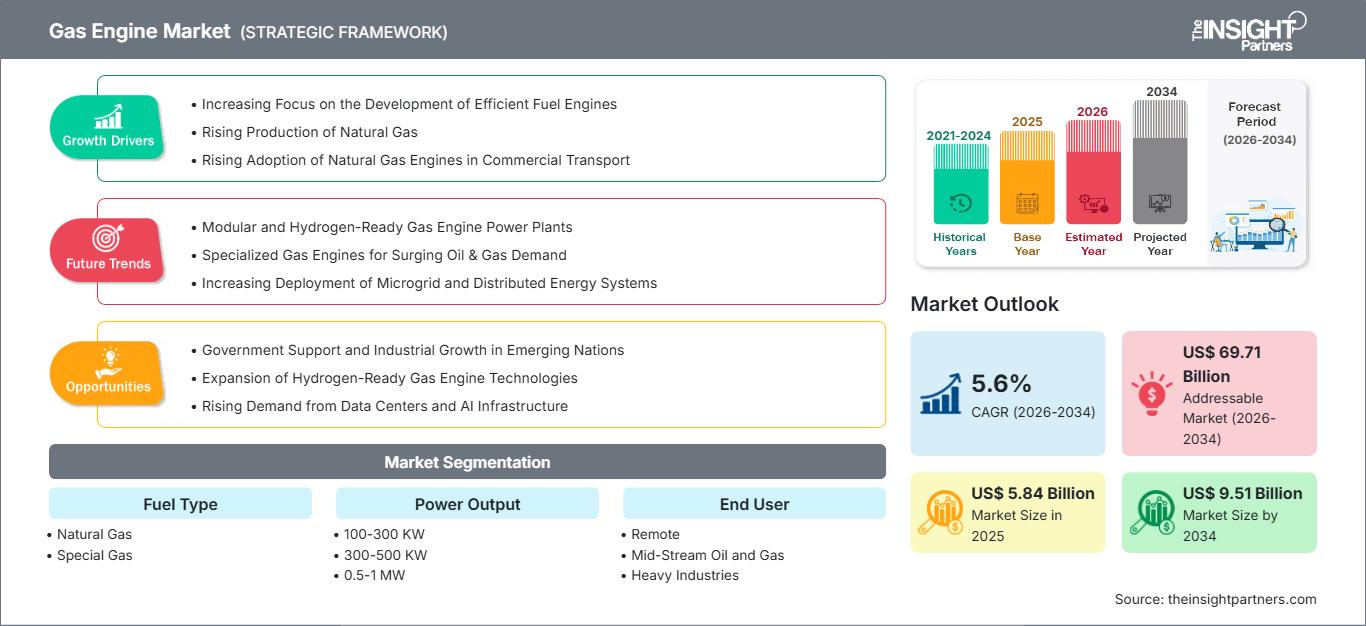
A new comprehensive market research report published by The Insight Partners reveals that the Global Gas Engine Market Size is projected to grow from US$ 5.84 billion in 2025 to US$ 9.51 billion by 2034, registering a CAGR of 5.6% during the forecast period from 2026 to 2034.
Market Growth Highlights:
- Market Projection: The Global Gas Engine Market is expected to reach US$ 9.51 billion by 2034.
- The U.S. Gas Engine Market is anticipated to grow at a CAGR of 6.53% during the forecast period.
- Gas engines are deployed in large-scale power generation, combined heat and power (CHP) systems, and backup energy applications, offering flexibility and operational efficiency compared to conventional diesel-based systems. The need for a dependable electricity supply, particularly for critical infrastructure and commercial operations, is driving adoption.
- Primary Growth Driver: Natural gas is generally considered a cleaner fossil fuel than coal and oil, as it produces fewer pollutants when burned. For this reason, it can play a key role in helping countries to reduce the carbon intensity of their energy systems. Increased financing is being directed towards discovering new natural gas reserves, building facilities to convert the gas into liquid form, and establishing the necessary supply chains, which, combined, will make the fuel more readily available to different parts of the world. As a result, gas engine adoption is getting a boost in the industrial, commercial, and power generation sectors.
- According to the International Energy Agency (IEA), in January 2026, global liquefied natural gas (LNG) supply increased by nearly 7% in 2025, with a significant portion of the growth occurring in the second half of the year as new liquefaction capacities became operational. The expansion of LNG capacity, particularly in North America, played a major role in increasing global supply and easing market constraints. Strong investment momentum continued in the LNG sector, with more than 90 billion cubic metres per year of LNG liquefaction capacity reaching final investment decision in 2025, representing one of the highest annual investment levels recorded.
- Key Segment: 5-10 MW remains dominant, while 0.5-1 MW exhibits the highest CAGR (6.7%).
Download Sample Report:
https://www.theinsightpartners.com/sample/TIPRE00015324
The high-power output and enhanced fuel efficiency offered by the gas engines of the range 5–10 MW are augmenting the segment growth. Gas engines are used in a wide range of applications, such as automotive manufacturing, cogeneration, commercial and industrial buildings, fast power, resiliency, IPPS and utilities. Further, enhanced technological developments in terms of efficiency are improving the performance of gas engines.
The improved electrical efficiency of gas engines, with more than 45%, is creating a lucrative opportunity for the segment in large power generation plants and combined heat and power (CHP) generation applications.
Key players include General Electric, Mitsubishi, and MAN Energy Solutions, known for their high-performance gas engines. For instance, General Electric Company enhanced its Jenbacher type 9 gas engine with 50.1% electrical efficiency. The rise of smart cities and modern infrastructure presents growth opportunities for power generation systems in this power range.
Government Support and Industrial Growth in Emerging Nations Fuels Industry Expansion:
Policies designed to enhance industrial competitiveness, promote energy efficiency, and encourage clean mobility are leading to an increased usage of advanced powertrains, including gas engines, in commercial, industrial, and hybrid transport sectors. Such programs consist of incentives, subsidies, and regulatory support, thus creating a favorable setting for the introduction of gas engine technologies. In India, the Ministry of Heavy Industries is taking initiatives to make the automotive, heavy electrical, and capital goods sectors more competitive and profitable.
As part of this, the Government of India sanctioned the Scheme to Promote Manufacturing of Electric Passenger Cars in India (SPMEPCI) on March 15, 2024. This program intends to speed up local EV production and help the adoption of low-emission technologies, at the same time contributing to economic growth and sustainable mobility.
In developing countries where industrialization, urbanization and energy demand are rapidly increasing, these types of government-supported programs would allow the development of hybrid solutions that mix natural gas or hydrogen engines with electrification. Gas engines can be a very attractive low-carbon option in commercial vehicles, industries and power plants that are used as a transition to clean energy, industries and power plants that are used as a transition to clean energy, therefore the market could greatly benefit from the infrastructure growth and from the worldwide pushing towards decarbonization.
Major Gas Engine Companies Include:
- INNIO
- Caterpillar Inc
- Cummins Inc
- Fairbanks Morse, LLC
- Kawasaki Heavy Industries Ltd
- Liebherr
- Everllence (MAN Energy Solutions SE)
- Mitsubishi Heavy Industries Ltd
- R Schmitt Enertec GmbH
- Wartsila Corp
- 2G ENERGY AG
- IHI Corp
- Guascor Energy S.A.U.
- Ningbo C.S.I. Power & Machinery Group Co., Ltd.
- Rolls-Royce Holdings Plc.
Gas Engine Market Segmentation Analysis:
Natural Gas Engine Segment to Registered Highest Market Share and the Highest CAGR
Fossil fuel combustion is the largest contributor to global air pollution, which affects the natural environment. Rapid research and development activities are being carried out to reduce the consumption of fossil fuels and pollution, owing to which the importance of natural gases has increased.
Natural gases are emerging as a promising solution to reduce diesel and petrol consumption. Stringent emission standards, global warming, and increasing CO2 legislation are increasing the adoption of natural gas engines. The natural gases are a rich mixture of hydrocarbons and are easily available due to their strong penetration. The benefits of natural gas are low emissions, clean burning, and lower cost than fossil fuels.
The absence of particulates and the clean properties of the natural gas are reducing the wear and tear of engines.
0.5 MW to 1 MW to Hold the Highest CAGR
Gas engines with power outputs from 0.5 to 1 MW are deployed in the industry sectors. These engines offer great features such as flexibility, a high level of reliability, and adaptability for the most challenging operating conditions. Also, they can operate on a variety of gases, including natural, propane, biogas, coal mine, and sewage gases, etc. Among the leaders in this area are Siemens, MAN Energy Solutions and Rolls-Royce, who equip the market with new technologies and efficient engines.
On the other hand, Caterpillar Energy Solutions has in its product line a 1 MW CG132B-16 natural gas generator that has high power density and, in addition, optimized lube oil management. The manufacturer has released this 1 MW natural gas generator aimed at steam generation and combined heat and power (CHP) applications. The increasing application of CHP systems and the requirement for energy resilience in the industrial sector are the major drivers of growth in this market segment.
Utilities Segment to Dominate Gas Engine Market Growth Rate
The demand for reliable, clean, and efficient energy in urban areas with utility services served to the public, such as electricity, is increasing globally. This segment differs from industrial applications by focusing on energy generation for public and grid distribution systems, demanding high operational efficiency and scalability.
A growing population and urbanization require a high amount of electricity, which creates a peak load on the electricity grid in some specific periods of winter. Hence, to handle such peak demand, utilities are adopting gas engine generators to generate electricity. Based on type, the utility segment is further categorized into grid, IPP, and others. The increasing demand for and the push toward energy transition technologies are driving the growth of gas engines in utilities.
To explore the valuable insights in the Gas Engine Market report, you can easily check a sample PDF of the report – https://www.theinsightpartners.com/sample/TIPRE00015324
Asia Pacific shows higher growth:
Asia Pacific had second largest share of the market in 2025. The rising population in countries, especially in India and China, leads to an increased demand for electricity. End users such as power-generating plants, manufacturing industries, and remote plants are using natural gas engines for power generation. China is a leading manufacturing hub for gas engines. India and Japan are considered significant contributors to regional growth.
Various countries are characterized by the mass production of gas engines required for manufacturing, power generation, and other industrial machinery. The manufacturing companies in India and China have substantial availability of skilled human resources. Owing to the increasing population in the region and comparatively low economic capabilities, countries have promoted the adoption of gas engines rather than electric energy. The high cost of electric energy plants and the lack of supporting infrastructure have slowed the market growth. Governments are promoting natural gas use in engines for low emissions. Thus, there is increasing utilization of natural gases as a prominent source in engines to meet regulatory standards.
Gas Engine Market Dynamics:
Driver: Increasing Focus on the Development of Efficient Fuel Engines
Several governments are imposing regulations to control the emissions of diesel and petrol engines, compelling engine manufacturers to opt for alternative fuel solutions such as natural gas. Gas engines release fewer emissions to generate a sufficient amount of power. The emission monitoring and regulatory bodies are imposing stringent regulations on using diesel engines and generators.
Various industries are deploying gas engines and generators for power generation to meet these regulatory standards. Cummins Inc. and Liberty Energy Inc. announced the launch of the industry’s first natural gas variable-speed, large-displacement engine to power Liberty’s digiPrime hydraulic fracturing platform, set for deployment in the first half of 2025. This follows the strategic partnership formed between the two companies in June 2024, aimed at jointly developing innovative technology for the completions services market. The Cummins HSK78G natural gas engine, initially introduced in March 2019 as part of a fixed-speed generator set for the power generation sector, has demonstrated exceptional reliability in providing consistent power across varying natural gas sources and operational environments.
The recent advancements for Liberty’s digiPrime platform have been built for the HSK78G engine to enhance its response time and load acceptance. This collaboration highlights a significant step in the ongoing growth of the gas engine market, which continues to innovate in areas of efficiency and operational performance, particularly within sectors such as hydraulic fracturing and energy production. Thus, the rise in the development of efficient fuel engines owing to stringent regulations related to gas engines is propelling the market growth.
Opportunity: Expansion of Hydrogen-Ready Gas Engine Technologies
Decarbonization and low-carbon energy solutions are the main focus of industries and governments. Hydrogen co-firing technology enables conventional natural gas engines to run on hydrogen blends, with the benefit of lowering CO2 emissions and at the same time preserving the operational reliability. In other words, this technique is a transitional way for the industries to start using clean fuels without the necessity of getting rid of old infrastructure or changing the engine designs entirely.
In July 2025, Mitsubishi Heavy Industries Engine & Turbocharger, Ltd. (MHIET) launched a new SGP M450 gas cogeneration system for the Japanese market in partnership with Toho Gas Co., Ltd. The system is capable of hydrogen co-firing at a maximum of 15% by volume while delivering a power output of 450 kW. The GS6R2 city gas engine was modified to support hydrogen blending, and over 500 hours of demonstration testing at the Toho Gas Technology Research Institute confirmed stable operation, reliable hydrogen mixing, and reductions in CO₂ emissions.
The engine’s city gas mono-firing and hydrogen co-firing allow seamless switching during operation, ensuring business continuity even during power outages. Its ability to maintain conventional load levels while integrating hydrogen demonstrates the practicality of hybrid fuel approaches for commercial and industrial applications. As hydrogen production and supply infrastructure expand globally, hydrogen-ready gas engines such as the SGP M450 provide an opportunity to meet sustainability targets while leveraging existing gas engine technology, opening new markets for clean energy solutions and hybrid power systems.
Challenge: High Initial Installation and Infrastructure Costs
Gas engine power generation systems require significant capital investment for equipment procurement, installation, and integration with existing energy infrastructure. In addition to the engine itself, projects require supporting components such as gas pipelines, fuel storage systems, compression equipment, and grid connection infrastructure. These additional requirements can increase the project cost, particularly in regions where natural gas distribution networks are developing.
For industrial facilities and power producers operating in emerging economies, the high upfront investment required for gas engine installations may act as a financial barrier. Organizations with limited capital budgets may prefer alternative power generation solutions that require lower initial investment, even if the long-term operational efficiency of gas engines is higher.
The development of natural gas infrastructure, including pipelines and supply networks, requires large-scale investments from governments and energy companies. In regions where such infrastructure is limited or underdeveloped, implementing gas engine systems may become economically challenging. The substantial capital expenditure associated with installation and infrastructure development can discourage potential investors and project developers, restraining the growth of the gas engine market.
Purchase Full Report (2025–2031 Forecast):
https://www.theinsightpartners.com/buy/TIPRE00015324
Recent Developments:
- In September 2024, INNIO Group announced its newest Waukesha VHP P9390X engine upgrade, designed for simpler operation and increased reliability. The VHP P9390X upgrade offers operators the latest engine technology, extending the life of the equipment by 60% while lowering downtime and reducing emissions across operating conditions.
- In March 2026, INNIO Group continues its growth trajectory with the official opening of its new plant in Hall in Tirol. The plant contributes to the supply of data centers with decentralized energy solutions. With the start of operations at the approximately 6,400-square-meter (69,000-square-foot) production facility, the company is strategically expanding its capacity to meet the growing global demand for Jenbacher engines.
Trending Related Reports:
- Special Gas Engine Market Size, Growth, Trends, Opportunities by 2031
- Natural Gas Engine Market - Global Growth, Size, and Forecast 2031
- Small Gas Engine Market Trends, Growth and Size - 2031
About The Insight Partners
The Insight Partners is a global market research and consulting firm delivering in-depth analysis and actionable insights across technology, media, telecommunications, healthcare, and industrial sectors. The firm supports organizations in identifying growth opportunities, understanding market dynamics, and making informed strategic decisions.
Contact Us:
If you have any queries about this report or if you would like further information, please contact us:
Contact Person: Ankit Mathur
E-mail: sales@theinsightpartners.com
Phone: +1-646-491-9876
Press Release -https://www.theinsightpartners.com/pr/gas-engine-market


Legal Disclaimer:
EIN Presswire provides this news content "as is" without warranty of any kind. We do not accept any responsibility or liability for the accuracy, content, images, videos, licenses, completeness, legality, or reliability of the information contained in this article. If you have any complaints or copyright issues related to this article, kindly contact the author above.
